
Do you need help? Contact us:
08
Sep
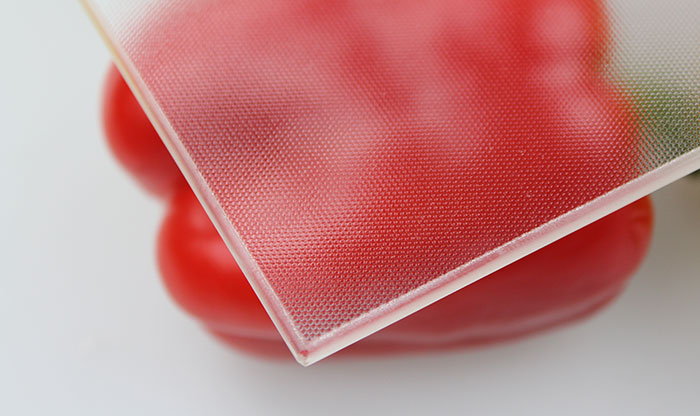
Diffuse glass is a high-performance covering material specifically developed for greenhouses, manufactured using a rolling technique. Two rollers with precision patterns press molten glass liquid into sheets, creating micro-textures on both glass surfaces—it is precisely these patterns that cause light to scatter. Different pattern styles and haze levels can be customized according to the cultivation needs of different regions and crops. With its excellent light-scattering performance, diffuse glass has gained widespread recognition from growers worldwide and has become one of the most popular choices for greenhouse roofing.
Diffuse glass achieves a base light transmittance of 91.5%, which increases to 97.5% after anti-reflective coating—significantly higher than ordinary float glass (approximately 89%). High transmittance ensures more sunlight enters the greenhouse, providing sufficient energy for photosynthesis. Research indicates that for every 1% increase in transmittance, total greenhouse production capacity increases by approximately 1%.
Diffuse glass converts direct light into uniform diffused light, eliminating localized hot spots and distributing light evenly across all areas of the greenhouse, thereby avoiding growth differences caused by uneven illumination. In vertical farming systems, scattered light can penetrate the canopy and eliminate shadows behind obstructions, allowing middle and lower leaves to receive adequate light, comprehensively improving photosynthetic efficiency.
Diffuse glass is available in multiple haze specifications: 5, 10, 20, 30, 40, 50, 70, and 75. These can be flexibly selected based on light conditions in different regions to ensure that light intensity throughout the day is suitable for crop growth. High-haze glass can reduce leaf surface temperature by approximately 5°C, effectively preventing growth retardation caused by high temperatures, with particularly notable effects during peak midday sunlight.
Safety: The spontaneous breakage rate of diffuse glass is only approximately 0.2% (2 per 1,000), exceeding the national standard requirement (≤0.3%), ensuring long-term greenhouse safety.
Durability: The coating is applied through an etching process, integrating the film layer with the glass substrate. This makes it resistant to mechanical cleaning and extends service life, effectively reducing maintenance costs.
By flexibly adjusting haze levels and scattering properties, diffuse glass enables greenhouses to adapt to light conditions in different climatic zones, improving crop quality. At the same time, scattered light effectively reduces irradiation intensity, minimizes photoinhibition effects, and promotes healthy crop growth.
Diffuse glass can increase effective daily light duration in greenhouses by approximately 2 hours, shorten crop growth cycles by about 1 week, and greatly improve production efficiency. Trials have demonstrated that the use of diffuse glass can increase crop yields by over 30%, with particularly outstanding results in flowers, tomatoes, cucumbers, and other crops.
Selecting the appropriate haze value requires comprehensive consideration of factors including crop type, regional light conditions, greenhouse structure, and economic costs:
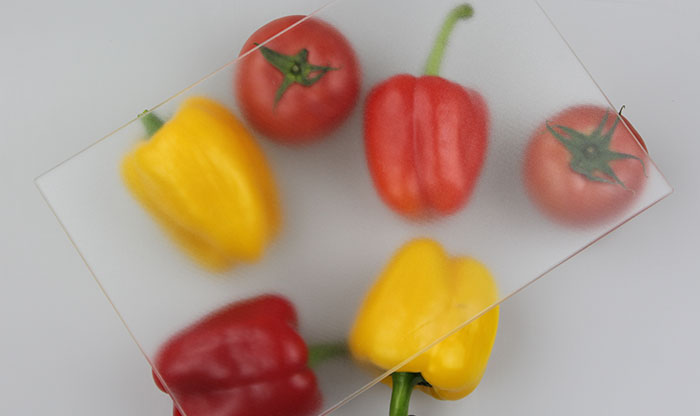
Sun-loving crops (tomatoes, cucumbers, peppers, etc.): Haze 10-30 is recommended, balancing scattering effects while maintaining transmittance.
Shade-tolerant or light-sensitive crops (some flowers, leafy greens, strawberries, etc.): Haze 40-75 is recommended to avoid photoinhibition and sunburn caused by intense direct light.
Regions with abundant sunlight (intense summer light): Haze 40-75 is recommended to reduce leaf temperature and minimize water evaporation.
Regions with weak sunlight: Haze 10-30 is recommended to increase transmittance and ensure sufficient light for photosynthesis.
East-west oriented greenhouses: Light is weak in the morning and evening but strong at noon. Lower haze levels can be chosen to improve transmittance, supplemented by higher haze to mitigate intense midday light.
North-south oriented greenhouses: Light distribution is relatively uniform, making medium haze levels appropriate.
Multi-layer covered greenhouses (double or triple glazing): Transmittance decreases with additional layers, so lower haze levels are recommended to compensate for light loss.
Limited investment budget: Choose medium haze specifications to balance initial investment and effectiveness.
Pursuit of high yield and quality: For high-value crops, investing in higher haze products can fully unlock yield-increasing potential.